Communication
Communication styles
-
Passive: avoid conflict, do not express feelings or opinions, do not stand up for themselves and use to agree to everything.
-
Aggressive: express feelings and opinions in a very strong way, sometimes violating others' rights, do not listen to others, think others are wrong.
-
Passive-aggressive: they are not comfortable to express feelings and opinions, body languange does not match with words, they area not totally transparent.
-
Assertive: express feelings and opinions in a way that respects the rights of others while defending own rights, listen to others, are honest and open, care about others' feelings.
Active listening
-
Pay attention: focus on the speaker, avoid distractions, do not interrupt.
-
Show that you are listening: nod, smile, make eye contact, use body language.
-
Provide feedback: summarize what you heard, ask questions, provide feedback.
-
Defer judgment: do not interrupt, do not argue, do not give advice.
-
Respond appropriately: be honest, assertive, respectful, and open.
Giving feedback
- Start with a micro-yes question to prepare brain to receive feeback! e.g., I have some good ideas for... can I share them with you?
- Data driven feedback: e.g. I noticed you did not attend to the meeting... instead of "you are unreliable" be specific about facts and data, no opinions or absoulte sentences.
- Provide meaning about the impact of the previous data: e.g. due that, we could not move forward... or that made us feel like you do not care about the team.
- End with a question or CTA: e.g. What do you think if from now on...?
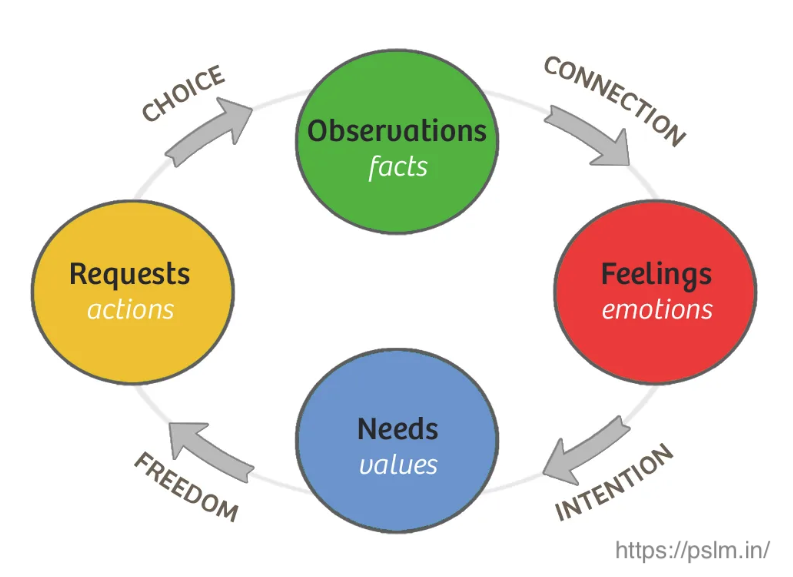
Conflict resolution - Non violent communication (NVC)
- Observations: facts without judgment
- Feeling: how you feel in relation to what you observe
- Need: what you need or value that causes your feeling
- Request: a specific request of what you would like to see happen