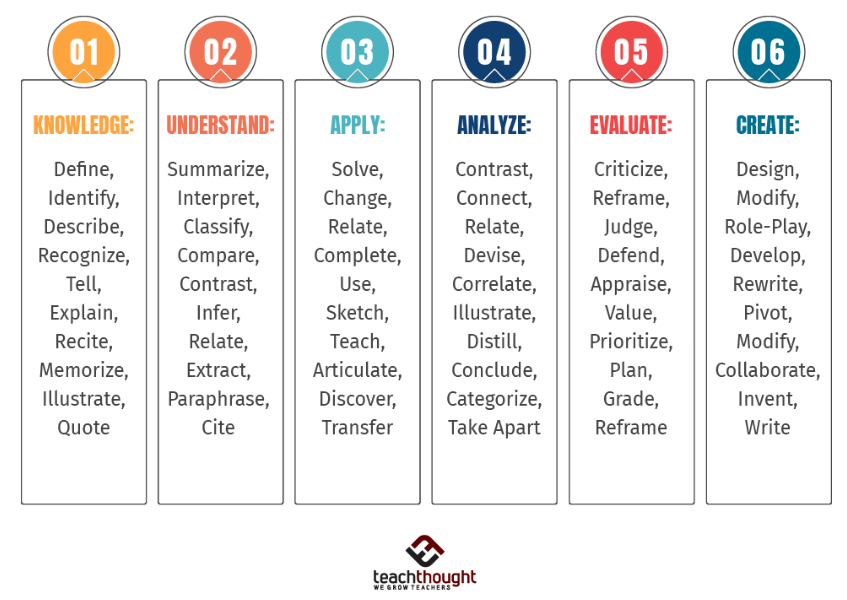
Bloom's Taxonomy
Bloom's Taxonomy is a framework that categorizes educational goals into levels of complexity and specificity. It helps educators design learning experiences that promote higher-order thinking skills. The taxonomy is divided into six levels, from the simplest to the most complex:
- Remember
- Understand
- Apply
- Analyze
- Evaluate
- Create
Examples of activities that correspond to each level include:
-
Start with Remembering: Ensure students can recall basic facts and concepts.
Activity: Flashcards for programming syntax. -
Move to Understanding: Help students explain and interpret these concepts.
Activity: Group discussions on how different code snippets work. -
Apply Knowledge: Encourage students to use their knowledge in practical scenarios.
Activity: Coding exercises that require implementing learned concepts. -
Analyze Information: Teach students to break down complex problems and see relationships.
Activity: Code reviews and debugging sessions. -
Evaluate Solutions: Guide students to assess and critique their own and others' work.
Activity: Peer reviews and performance analysis of different code solutions. -
Create New Work: Challenge students to design and build new projects.
Activity: Capstone projects or hackathons where they create software applications.